
Reviewed · COMMUNIST & YUGOSLAV HISTORY TOURS
Tito and History Vintage Car Tour
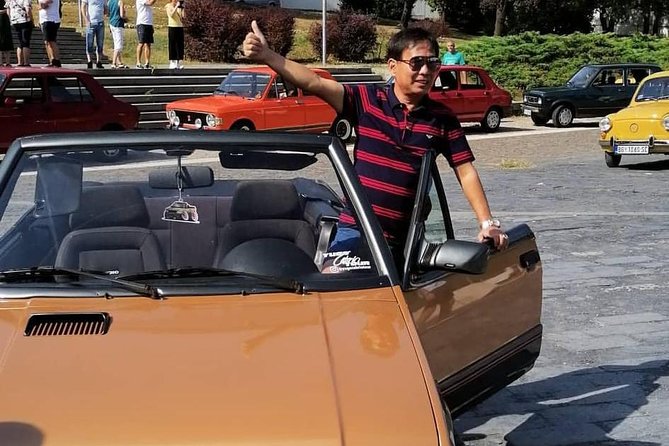
Yugoslavia still rides through Belgrade. This private 2 to 3 hour outing pairs vintage Yugoslavian cars with major sights tied to Tito’s era, the Non-Aligned Movement, and Belgrade’s bold modernist buildings. You can request pickup or meet at Dragoslava Jovanovića 14, then travel between stops with a guide who explains both the cars and the political story behind them.
I especially like the unusual focus on the Yugo convertible, a car that has become a worldwide punchline but also says a lot about Yugoslav industry and daily life. I also like the route’s mix of famous sights and less ordinary stops, including the Western City Gate, Palata Srbije, and the Museum of Yugoslavia. The main consideration is price: at $144, this is best value for a private group that wants a focused local guide, not for someone looking only for a quick car ride.
The experience earns a 5.0 rating from 11 ratings, with 100 percent recommending it. Jovana receives specific praise for being passionate and well informed, which matters here because the tour depends as much on explanation as on the vehicles themselves.
In This Review
- Key points before you book
- Why old cars make a good guide to Yugoslavia
- Starting at the National Assembly area
- Park of Friendship and the Non-Aligned Movement
- Palata Srbije and socialist modernism
- The Western City Gate and Genex Tower
- Museum of Yugoslavia and the House of Flowers
- What the private format changes
- Snacks, transport, and timing
- Is $144 a fair price?
- Who will enjoy this tour most?
- Should you book the Tito and History Vintage Car Tour?
- FAQ
- Where does the Tito and History Vintage Car Tour start?
- Where does the tour end?
- How long does the tour last?
- Is this a private tour?
- Is admission to the Museum of Yugoslavia included?
- Are food and drinks provided?
- What happens if bad weather cancels the tour?
- Can I cancel for a full refund?
Key points before you book
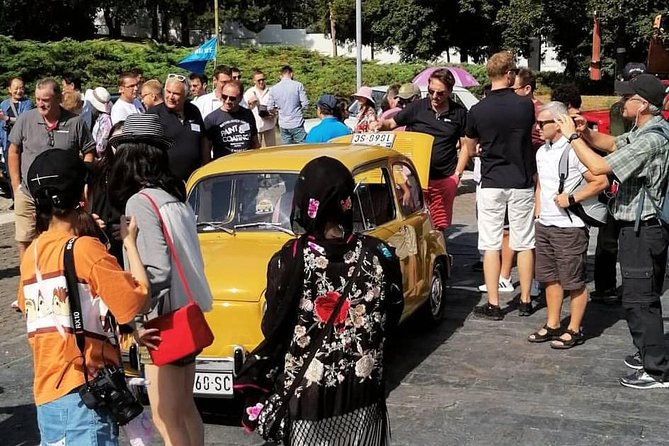
- Yugoslav cars are the main attraction: You learn about the Yugo, including the unusual convertible version, instead of simply posing beside old vehicles.
- The route connects Tito-era Belgrade: Stops include Palata Srbije, Park of Friendship, the Museum of Yugoslavia, and the Western City Gate.
- It is private: Only your group takes part, giving you more room to ask questions and set the pace within the planned route.
- Snacks and soda are included: You do not need to budget for refreshments during the ride.
- The Museum of Yugoslavia admission is covered: There is no need to pay an entrance fee at that stop.
- Pickup is available: You can request pickup or go to the central meeting point at Dragoslava Jovanovića 14.
Why old cars make a good guide to Yugoslavia
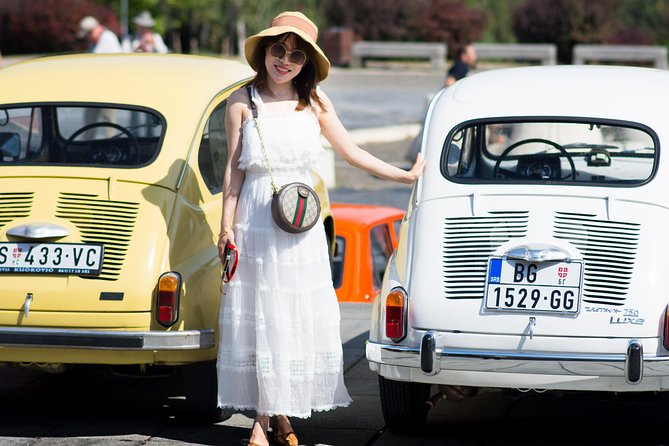
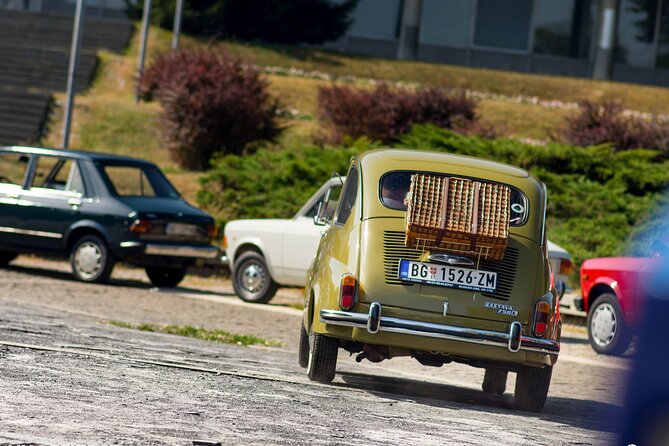
A vintage car gives this tour a useful human scale. Political history can feel distant when you see it only through monuments and official buildings. A Yugo brings the subject down to the level of family trips, factory work, status, shortages, design choices, and jokes about national pride.
The tour presents the Yugo with humor, including the familiar claim that it was the worst car in the world. That joke is part of the appeal, but the experience is not limited to a punchline. You learn about the car itself and the setting that produced it, including the Yugo convertible.
The car theme also helps link the stops. Belgrade’s grand government buildings can seem disconnected from one another if you visit them on your own. Here, the guide ties them to the former Yugoslavia, Tito, international diplomacy, and the country’s effort to present a modern national identity.
Because the outing is private, you can ask for more detail about the cars, the buildings, or Tito’s period. That flexibility is especially useful if your group includes one person who loves cars and another who mainly wants architecture or twentieth-century history.
More Yugoslav history tours:
- Red Belgrade Communist Tour
★ 5.0 · 78 reviews - Architecture of New Belgrade – Brutalism Decoded
★ 4.5 · 24 reviews - Communist Tour in Belgrade
★ 4.5 · 19 reviews
Starting at the National Assembly area
The first stop is the House of the National Assembly of the Republic of Serbia, with about 15 minutes to look around. The description connects the site with the Obrenović dynasty and says it now houses the City Assembly of Belgrade.
This is a short orientation stop rather than a full interior visit. Admission is free, and the value comes from setting the scene. You begin with a major civic building before moving into the stronger Yugoslav themes of the route.
I would not book this tour just for the National Assembly stop. Fifteen minutes is enough for an outside look and an introduction, but not enough for a detailed architectural visit. Treat it as the first chapter, not the main event.
The stop also gives your guide a chance to explain how Belgrade’s royal, national, and socialist periods overlap. That broad frame helps you understand why the tour does not focus only on cars. The vehicles are the thread, while the city supplies the setting.
Park of Friendship and the Non-Aligned Movement
Park of Friendship, or Park Prijateljstva, receives about 20 minutes. It is linked to the Belgrade Conference of September 1961, known as the First Summit of the Non-Aligned Movement.
The park’s Peace Alley is a 180-meter path lined by two rows of trees. Heads of state who attended the summit planted the trees as symbols of support for world peace. The names connected with the park include Queen Elizabeth II, Margaret Thatcher, Robert Mugabe, Jimmy Carter, Indira Gandhi, and Nicolae Ceaușescu. Members of the Rolling Stones are also listed among those who planted trees.
This is one of the route’s most interesting stops because it shows Belgrade acting as a meeting place outside the main Cold War blocs. You see how Yugoslavia tried to play an independent international role, rather than fitting neatly into either the Western or Soviet camp.
The park is also described as incomplete and marked by the hopes and failures of its time. That tension gives the stop more weight than a simple walk among trees. You are looking at a public project built around peace, diplomacy, and idealism, while also hearing how grand plans can remain unfinished.
The 20-minute visit is enough for the guide’s explanation and a short look at the Peace Alley. If you want a long park walk, this tour will feel brief. If you want a clear introduction to the Non-Aligned Movement, it is a strong use of time.
Palata Srbije and socialist modernism
Palata Srbije gets about 20 minutes and is one of the route’s architectural highlights. It is described as Belgrade’s largest and most spectacular modernist building, with a history tied to the Yugoslav state.
You see the exterior and hear about the building’s past. The inside is closed to the public, but the guide can show you pictures of its interior. That small detail matters because the building’s public face tells only part of the story.
This is a good stop for anyone who likes modernist architecture, grand civic projects, or the visual language of former socialist states. Palata Srbije was designed to project confidence and importance. Its scale reflects the ambitions of a country that wanted to be taken seriously on the world stage.
Do not expect an indoor tour. The appeal is the building itself, the surrounding explanation, and the chance to see photographs of spaces you cannot enter. Your guide’s commentary is what turns a large government building into a useful historical stop.
More Historical Tours in Belgrade:
- A Crash Course through Serbian History
★ 5.0 · 58 reviews - History and Culture in my Belgrade
★ 5.0 · 41 reviews - NATO Bombing of Belgrade Historical Tour
★ 5.0 · 17 reviews - Football tour: Red Star and Partizan Ultras History
★ 5.0 · 14 reviews
The Western City Gate and Genex Tower
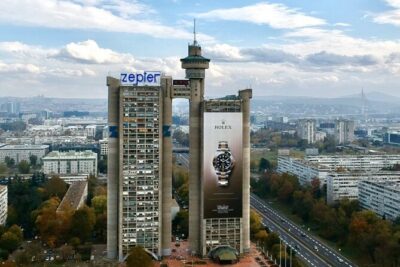
The Western City Gate, also called Genex Tower, is the tour’s sharpest change of mood. This 36-story Belgrade skyscraper was designed in 1977 in the brutalist style.
The structure consists of two towers joined by a two-story bridge. A revolving restaurant sits at the top. Its unusual profile makes it one of the city’s most recognizable examples of late twentieth-century architecture.
For fans of brutalism, this may be the visual high point of the route. The tower is not polished or conventionally pretty. Its appeal comes from strong shapes, exposed structural ideas, and the confidence of its design.
The stop is listed without a fixed duration, so the exact amount of time may depend on the day’s schedule and the group’s interest. You should think of it as an exterior architecture stop rather than a visit to the revolving restaurant or an indoor tour.
The Genex Tower also fits the car theme in a broader way. It represents the same era of Yugoslav ambition that produced domestic cars and large state buildings. One is built for personal transport, the other for a modern city. Together, they show a country trying to create its own style.
Museum of Yugoslavia and the House of Flowers
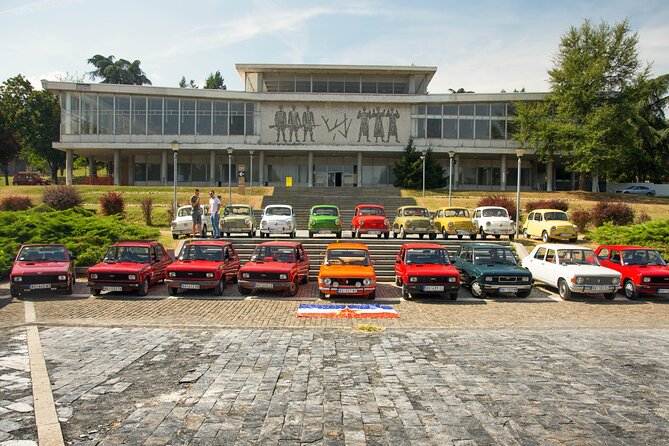
The Museum of Yugoslavia is the longest stop, at about 40 minutes, and admission is included. The museum began in 1962 to collect gifts presented to Tito by people in Yugoslavia and by leaders from around the world.
After Tito’s death, the museum organization expanded to include the House of Flowers, his former residence and tomb, as well as other related buildings and collections. More than 200,000 objects are organized into 20 collections.
That background makes the museum different from a standard chronological history museum. Its starting point was not simply to tell the story of Yugoslavia from beginning to end. It was built around gifts, state ceremony, Tito’s public role, and the way Yugoslavia represented itself.
The 40-minute visit gives you a useful introduction, but it is not enough to see every collection. If you have a strong interest in Tito or twentieth-century Balkan history, you may want to return on your own for a longer visit. On this tour, the museum works as a concentrated final chapter.
The House of Flowers is especially important to the story because it contains Tito’s tomb. The museum complex brings together personal objects, diplomatic gifts, state memory, and the physical remains of the country’s most influential leader. Your guide can help you read those objects in context instead of treating them as isolated curiosities.
What the private format changes
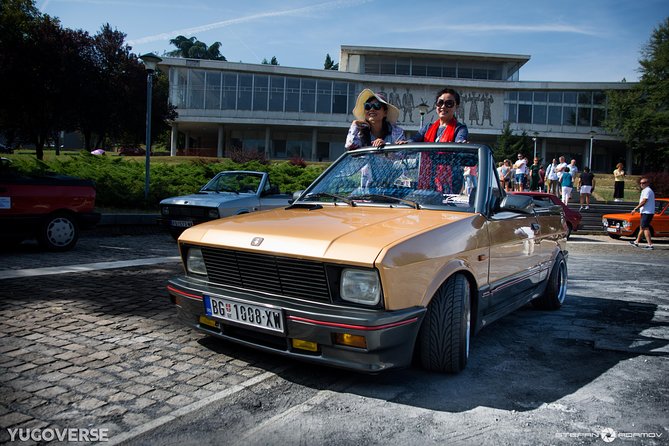
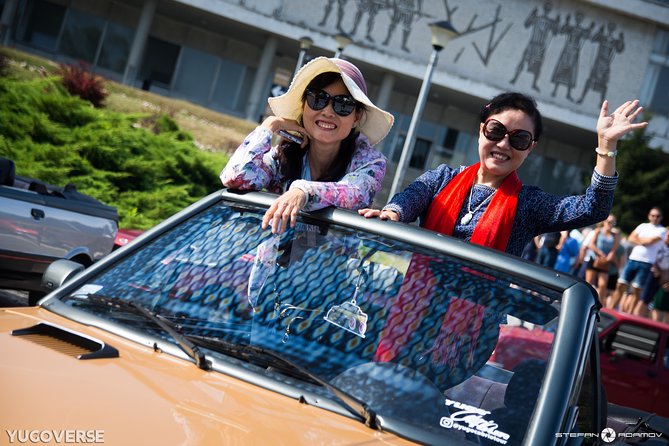
A private tour is more expensive than a shared city excursion, but it changes the experience. Only your group takes part, so you can ask questions without worrying about slowing down a busload of people.
That matters on a subject with many names, dates, and competing viewpoints. You may want to ask about the Yugo’s reputation, Tito’s international role, or why brutalist buildings look the way they do. A private guide can spend more time on the subjects that hold your attention.
The private format does not mean every part is fully customized. The listed route remains the backbone, and several stops have set time estimates. Still, the small-group setting should make the commentary easier to follow and the car experience more personal.
Jovana is the guide specifically praised for passion and strong command of the subject. If she is assigned to your booking, her enthusiasm should add real value. Confirmation is subject to availability and is sent within 48 hours, so you should not assume a particular guide until your reservation is confirmed.
Snacks, transport, and timing
The total duration is about 2 to 3 hours. That makes the tour easy to fit into a day of sightseeing, especially if you want one activity that combines transport, architecture, and museum time.
Pickup is offered, or you can go to the meeting point at Dragoslava Jovanovića 14 in Belgrade. The tour ends at a different location, with the exact end details supplied for the activity. This can be convenient if you want to continue sightseeing rather than return to the starting point.
Snacks and soda are provided along the way. This is a modest extra, but it helps on a compact route with several stops. All fees are included, so you should not need to make small cash payments during the activity.
The experience runs Monday through Sunday from 9:00 a.m. to 9:00 p.m. The stated hours describe the operating window, not necessarily the exact departure time you will receive. Confirm your preferred start when booking.
The tour requires good weather. If poor weather forces a cancellation, you are offered another date or a full refund. Free cancellation is available until 24 hours before the start time. Inside that 24-hour window, the payment is not refunded and changes are not accepted.
Is $144 a fair price?
At $144, this is not a budget sightseeing ride. The value depends on the size of your group and how much you want from the guide.
For one person, the cost is high for a 2 to 3 hour activity. For a private group splitting the price, it becomes easier to justify, particularly because transportation, snacks, soda, included fees, and Museum of Yugoslavia admission are bundled together.
You are also paying for a narrow subject that is difficult to find in a standard city tour. The Yugo and its convertible version give the experience a clear identity. The route then adds major Yugoslav-era sites that you might otherwise reach by separate taxi rides or a more general sightseeing tour.
I would consider the price fair for a group that values specialist storytelling and wants to see several spread-out places efficiently. I would skip it if your main goal is a cheap overview of central Belgrade, or if you have no interest in cars, Tito, modernist architecture, or the former Yugoslavia.
Who will enjoy this tour most?
This experience suits you best if you like unusual city tours with a strong theme. It is a good match for people interested in cars, twentieth-century politics, socialist architecture, Tito, or the Non-Aligned Movement.
It also works well for couples, families, and small private groups who prefer questions and conversation over a fixed large-group presentation. Most people can participate, and service animals are allowed. The meeting point is near public transportation.
Architecture fans should pay special attention to Palata Srbije and Genex Tower. Museum lovers will value the Museum of Yugoslavia, though they should remember that the 40-minute visit is a taste rather than a full study.
The tour may be less suitable if you want extensive time inside museums, long walks, or a conventional list of Belgrade’s oldest landmarks. The route is strongest when you accept its focus on recent history and Yugoslav identity.
Should you book the Tito and History Vintage Car Tour?
Book it if you want Belgrade explained through a Yugo, Tito-era buildings, and the country’s international story. The combination is unusual, the private format is practical, and Jovana’s praised enthusiasm suggests that the guide can make the subject lively rather than dry.
Before booking, check the group size and calculate the $144 cost across your party. Ask yourself if you are happy with a short Museum of Yugoslavia visit and mostly exterior architecture stops. If the answer is yes, this is a focused and memorable way to see a side of Belgrade that ordinary city tours often skip.
FAQ
Where does the Tito and History Vintage Car Tour start?
The tour starts at Dragoslava Jovanovića 14, Beograd 11000, Serbia. Pickup can also be requested.
Where does the tour end?
The activity ends at a different location from the starting point. The exact end details are provided with the activity information.
How long does the tour last?
The tour lasts approximately 2 to 3 hours.
Is this a private tour?
Yes. Only your group takes part in the activity.
Is admission to the Museum of Yugoslavia included?
Yes. Admission to the Museum of Yugoslavia is included.
Are food and drinks provided?
Snacks and soda are provided during the tour.
What happens if bad weather cancels the tour?
You are offered a different date or a full refund if poor weather causes cancellation.
Can I cancel for a full refund?
Yes. You can cancel at least 24 hours before the start time for a full refund. Cancellations within 24 hours are not refunded.
Just added around Belgrade
- Private Wine Tasting by Party in Belgrade★ 5.0 · 3 reviews
- Private Walking Tour of Belgrade and Old Zemun★ 5.0 · 3 reviews
- E-Scooter Serbian Food Tour★ 5.0 · 3 reviews
- Belgrade: The White Emigration in Serbia in the Wake of the Russian Revolution★ 5.0 · 3 reviews
- Zica and Studenica monastery From Belgrade★ 5.0 · 3 reviews
- Belgrade Private Driving & Walking Tour★ 5.0 · 4 reviews
- Feel Belgrade Welcome tour★ 4.5 · 3 reviews
- Belgrade Fashion and Design Tour – Discover Local Designers★ 5.0 · 4 reviews
Communist & Yugoslav History Tours, compared.
Architecture of New Belgrade – Brutalism Decoded
Read our review →

Browse the lists this tour appears in