
Reviewed · COMMUNIST & YUGOSLAV HISTORY TOURS
Architecture of New Belgrade – Brutalism Decoded
Concrete tells Belgrade’s story. This private, English-language tour links New Belgrade’s daring modernist buildings with the politics and daily life behind them. I like the close look at Genex Tower and the way the guide connects architecture with ordinary life in the housing blocks. I also like the small group format, which gives you room to ask questions instead of trailing behind a flag.
The main drawback is pace. The advertised duration is about two and a half hours, but one poor account describes a shorter experience and little personal connection. Since this tour covers five buildings and several major themes, I would confirm the timing when you book.
In This Review
- Key things to know before you book
- Why New Belgrade rewards a closer look
- Starting at the Museum of Contemporary Art
- Park of Friendship and the Non-Aligned story
- The government building and a political shift in concrete
- Genex Tower, New Belgrade’s unforgettable gateway
- Sava Center and the practical side of grand design
- Block 23 and the city inside the city
- What the private format adds
- Is $86.42 good value?
- Who should book this New Belgrade tour?
- My verdict on Architecture of New Belgrade
- FAQ
- How long does the tour last?
- Where does the tour begin?
- Where does the tour end?
- Is the tour offered in English?
- Is this a private tour?
- Which buildings and sites are included?
- Is admission to the Museum of Contemporary Art included?
- Can I cancel for a full refund?
Key things to know before you book
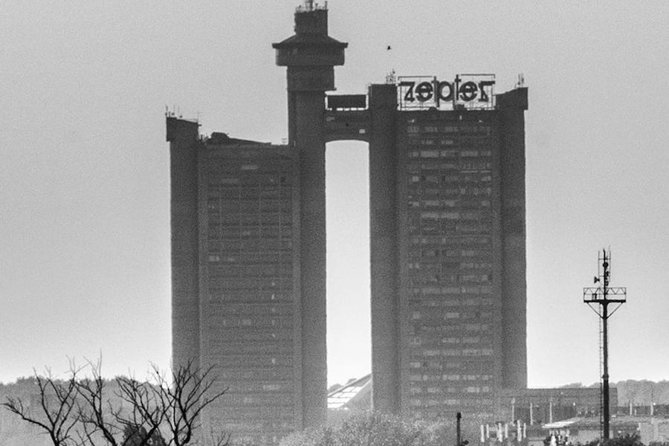
- Genex Tower is the visual star: You get a close look at the 30-floor Western City Gate, one of New Belgrade’s most striking buildings.
- This is more than a building tour: The guide explains Yugoslavia’s political shifts, the Non-Aligned Movement, and daily life in socialist housing blocks.
- The private format matters: Only your group participates, so you can ask about architecture, history, or life in modern Belgrade.
- The tour covers five main sites: You visit the Museum of Contemporary Art, Park of Friendship, Genex Tower, Sava Center, and Primary School Laza Kostić.
- It ends at Sava Center: The starting point is the Museum of Contemporary Art at Ušće, while the finish is at Sava Center.
- The price is $86.42 per person: That is a serious outlay for two and a half hours, but more reasonable if you value private guiding and specialist subject matter.
Why New Belgrade rewards a closer look
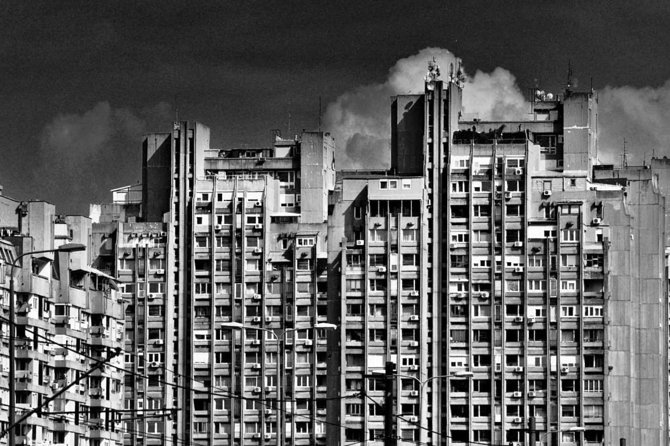
Many first-time visitors focus on Belgrade’s old fortress, riverside promenades, and café streets. New Belgrade offers a different story. Its wide spaces and huge concrete buildings reflect the ambitions of socialist Yugoslavia, a country that tried to follow its own political path rather than simply copy Moscow or the West.
That makes this tour useful. You are not just looking at unusual façades and asking if they are beautiful. You are learning why these buildings appeared, what they were meant to do, and how people used them.
The word brutalism can sound like shorthand for cold concrete. Here, that label needs more care. The buildings on this route include modernist volumes, concrete expressionism, marble façades, large public institutions, and planned housing. Some are imposing. Others are surprisingly elegant once you understand their design.
I especially like the promise of connecting architecture with ordinary life. The guide brings in personal stories about living in New Belgrade’s blocks during the good decades of the 1960s, 1970s, and 1980s, along with the harder realities of the 1990s. That human detail gives the concrete a pulse.
More Yugoslav history tours:
- Red Belgrade Communist Tour
★ 5.0 · 78 reviews - Communist Tour in Belgrade
★ 4.5 · 19 reviews - E-Scooter Communist Yugoslavia Tour
★ 5.0 · 15 reviews
Starting at the Museum of Contemporary Art
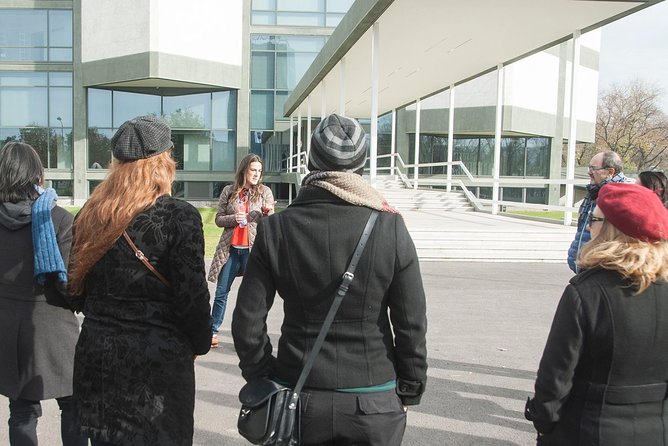
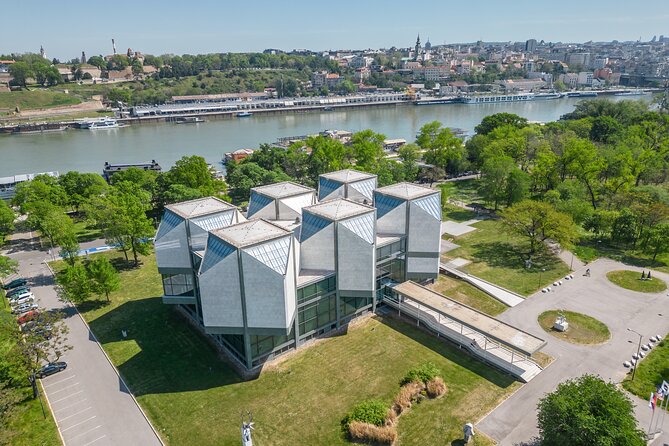
You meet the guide in front of the Museum of Contemporary Art at Ušće. The location is easy to identify, and the museum provides a sensible starting point for a walk through New Belgrade’s modernist ambitions.
The museum’s 1960s design is the first lesson in avoiding easy labels. Its sculpted volumes and precious marble façades do not fit the usual image of socialist construction as plain, cheap, or purely functional. The building asks you to look at Yugoslav modernism on its own terms.
You spend about 20 minutes here. Admission to the museum is not included, so the tour focuses on the exterior and architectural explanation rather than a museum visit. If you want to see the art collection inside, plan that separately.
This is a good opening stop because it gives you a visual vocabulary for the rest of the outing. Pay attention to the shapes, materials, and relationship between the building and its open setting. Later, you will see how those ideas become larger and more forceful across New Belgrade.
Park of Friendship and the Non-Aligned story
The next stop is Park of Friendship, or Park Prijateljstva. You spend around 15 minutes here, and there is no admission charge.
The park is tied to the Non-Aligned Movement, founded in Belgrade in 1961 by countries seeking a position outside the main Cold War blocs. The heads of state planted trees here as symbols of peace. That simple act gives the park a political meaning far greater than its appearance might suggest.
This stop helps explain why New Belgrade cannot be read only through architecture. Its buildings and public spaces were part of a national project. Yugoslavia wanted to present itself as modern, independent, international, and capable of hosting major political gatherings.
I would pay close attention to this section if you know little about Yugoslavia’s place in the Cold War. It provides essential context for the monumental government buildings and congress facilities that follow.
The government building and a political shift in concrete
The route continues by passing the huge government building. This is a drive-by rather than one of the numbered walking stops, but it adds an important piece of political background.
The building began during an earlier phase of Yugoslav politics and was still under construction when the country moved away from Stalin’s model. That change affected the country’s direction, identity, and relationship with the Soviet Union.
You do not get a long visit here, so think of it as a moving history lesson. The point is not to inspect every detail of the façade. It is to understand that New Belgrade was built during political change, not in one fixed period with one unchanging style.
This brief section also helps prevent a common mistake: treating all socialist-era architecture as one uniform category. The political setting shifted, and the architecture shifted with it.
Something different for your next free day:
- Northern Serbia: Sremski Karlovci and Novi Sad Full-Day Tour from Belgrade
★ 5.0 · 425 reviews - Day Trip from Belgrade: Gems of Eastern Serbia
★ 5.0 · 424 reviews - Belgrade Nightlife Bar Pub Club Crawl with Drinks
★ 5.0 · 277 reviews - Taxi to/from Belgrade Airport to/from Belgrade City Center
★ 5.0 · 241 reviews
Genex Tower, New Belgrade’s unforgettable gateway
At Narodnih heroja 45, you get a close look at Genex Tower, also called the Western City Gate of Belgrade. This is the tour’s clearest crowd-pleaser, and for good reason.
The complex rises 30 floors and was built about 40 years ago. Its bold form is hard to confuse with anything else in the city. It has become one of the most photographed modern buildings in Belgrade, but the tour gives you more than a quick picture stop.
Genex Tower is presented as the first smart building in the Balkans and as an important example of brutalist architecture in international architectural writing. Those claims help place it in a wider design story. This was not simply a tall apartment or office block. It was a statement about technology, confidence, and the future.
You spend about 20 minutes here, with free admission. The close-up view matters because the scale and details are easy to miss from a passing vehicle. Give yourself time to take in the relationship between the two parts of the complex and the way the structure acts as a gateway into the city.
I would book this experience partly for Genex Tower alone if you enjoy modern architecture. Still, keep your expectations sensible. This is an exterior-focused visit, not a full inside tour of the tower.
Sava Center and the practical side of grand design
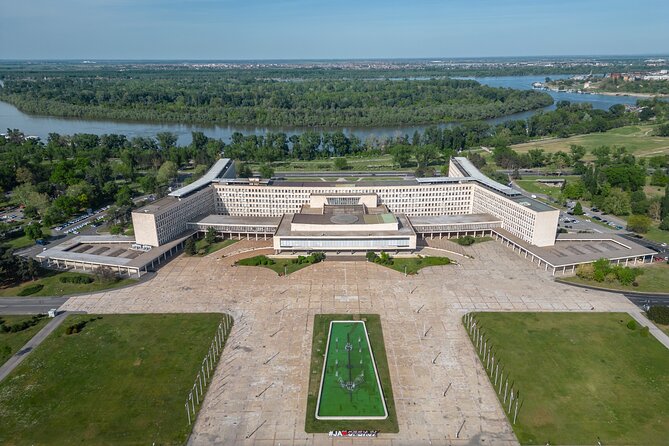
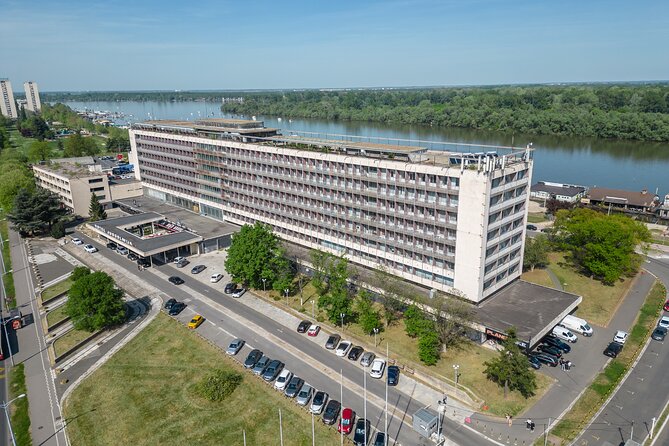
The final major building stop is Sava Center, at Milentija Popovića 9. The center was built in the late 1970s in record time and was the first building of its type in this part of Europe.
Its purpose was practical as well as symbolic. A large congress center allowed Yugoslavia to host international meetings and present itself as a serious global player. The building is still in use, which gives the stop a useful sense of continuity.
You spend about 15 minutes here. The tour points out interior solutions that remain surprisingly fresh after more than 40 years. That detail is important because brutalist architecture is often judged only from the outside. Inside, good planning, circulation, and public use can make a building feel far more welcoming than its concrete shell suggests.
The tour ends here, which is convenient if you want to continue exploring New Belgrade or arrange your next stop from the same area. The end point is clearly listed as Sava Center, while the start is at the Museum of Contemporary Art.
Block 23 and the city inside the city
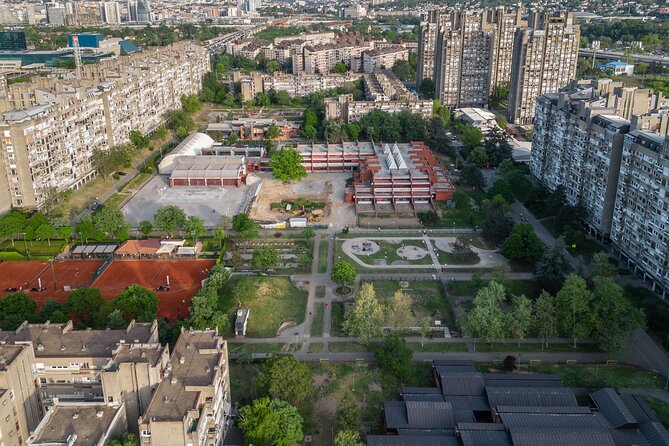
The stop at Primary School Laza Kostić takes you into Block 23, described as the most representative public housing project on the route. This is where the tour shifts from monumental architecture to the everyday city.
The idea was to provide a complete environment for residents. Apartment buildings were joined by a school, kindergarten, sports courts, and a small shopping center. In theory, you could live much of your daily life within the block instead of crossing the city for every basic need.
That arrangement tells you something about socialist urban planning. Housing was not considered in isolation. The planners thought about education, recreation, shopping, and community facilities as part of one organized district.
You spend about 15 minutes here, including a look at the school and the surrounding block. The architecture is described as concrete expressionism, but the key point is how the spaces were intended to function.
This may be the most rewarding stop for anyone interested in daily life. The guide shares personal stories about the blocks during their golden decades, then contrasts them with the difficult conditions of the 1990s. That shift gives you a more honest view than a simple celebration of socialist planning.
You can admire the ambition without pretending the system always worked perfectly. Planned facilities may have offered convenience and community, but the later stories of decline add needed balance.
What the private format adds
This is a private tour, so only your group participates. That changes the feel of a specialist architecture outing. You can stop to ask why a building was placed where it is, how residents used a block, or how Yugoslav modernism differed from Soviet design.
The guide named in the positive feedback is Xenia. Her style was praised for explaining both the architecture and the humanity of everyday city life. That combination is exactly what this route needs. A guide who only lists dates and architects would leave you with photographs but little understanding.
The tour is offered in English. Confirmation arrives at booking, and the meeting point is easy to find in front of the Museum of Contemporary Art. The area is near public transportation, and most people can participate.
The private format is also the main reason the price can make sense. At $86.42 per person, this is not a casual add-on for someone watching every dinar. For a couple or small group sharing the experience, the cost buys focused attention and a route that would be difficult to reconstruct from general sightseeing alone.
Is $86.42 good value?
The value depends on what you want from Belgrade. If you only want a quick look at Genex Tower, you can see the exterior independently. The same is true of Sava Center and several other sites.
You are paying for interpretation, transport between parts of the route, political context, and access to personal stories about New Belgrade. The subject is specialized, and the five-site route covers a lot in roughly two and a half hours.
The price feels strongest for architecture fans, students, photographers, and visitors who have already seen central Belgrade’s standard sights. It is also a good choice if you prefer a private conversation to a large group walk.
The value is weaker if you expect long visits inside each building. Admission to the Museum of Contemporary Art is not included, and the stops are short, generally 15 or 20 minutes. This is a carefully selected overview, not a full architectural survey.
One rating summary gives the experience 4.6 out of 5, with 92 percent recommending it. That is a strong signal, but the single very poor account is worth noting. It describes less than two hours, little empathy, and limited preparation. I would contact the provider, Walking Belgrade, before departure to confirm the meeting time and expected length.
Who should book this New Belgrade tour?
I would choose this tour if you enjoy buildings as clues to politics and society. You do not need formal architecture training. Curiosity is enough, especially if you want to understand why Belgrade looks so different beyond the old center.
It suits you particularly well if you:
- Want a private experience in English
- Have an interest in brutalism or modernist design
- Prefer local stories over a standard city highlights route
- Want to see Genex Tower and Sava Center with context
- Have already visited Belgrade’s main historic sights
- Like learning how housing projects were meant to support daily life
You may want to skip it if you dislike concrete architecture, prefer long interior visits, or want a relaxed stroll with plenty of free time. The pace is fairly full, and several stops are short.
Free cancellation is available if you cancel at least 24 hours before the start time. Changes or cancellations inside that window are not accepted for a refund.
My verdict on Architecture of New Belgrade
I would book this tour when I wanted to see the Belgrade that many short city visits miss. Genex Tower is the eye-catching prize, but the stronger reason to go is the connection between architecture, Cold War politics, international diplomacy, and ordinary family life.
The private format and personal storytelling give the experience real value. Just remember that the tour is an exterior-led overview with brief stops, not an extended visit inside five buildings. Confirm the timing in advance, then bring an open mind and a camera.
If that balance suits you, Architecture of New Belgrade: Brutalism Decoded is a thoughtful way to understand a bold, complicated part of the city.
FAQ
How long does the tour last?
The experience lasts approximately 2 hours and 30 minutes.
Where does the tour begin?
The meeting point is in front of the Museum of Contemporary Art at Ušće 10 in Belgrade.
Where does the tour end?
The tour ends at Sava Center, Milentija Popovića 9, Belgrade 11000.
Is the tour offered in English?
Yes. The experience is offered in English.
Is this a private tour?
Yes. Only your group participates in the activity.
Which buildings and sites are included?
The route includes the Museum of Contemporary Art, Park of Friendship, Genex Tower, Sava Center, and Primary School Laza Kostić. The route also passes the large government building.
Is admission to the Museum of Contemporary Art included?
No. Admission to the Museum of Contemporary Art is not included. The other listed stops have free admission.
Can I cancel for a full refund?
Yes, if you cancel at least 24 hours before the experience start time. Cancellations or changes made less than 24 hours before the start are not accepted for a refund.
Just added around Belgrade
- Private Wine Tasting by Party in Belgrade★ 5.0 · 3 reviews
- Private Walking Tour of Belgrade and Old Zemun★ 5.0 · 3 reviews
- E-Scooter Serbian Food Tour★ 5.0 · 3 reviews
- Belgrade: The White Emigration in Serbia in the Wake of the Russian Revolution★ 5.0 · 3 reviews
- Zica and Studenica monastery From Belgrade★ 5.0 · 3 reviews
- Belgrade Private Driving & Walking Tour★ 5.0 · 4 reviews
- Feel Belgrade Welcome tour★ 4.5 · 3 reviews
- Novi Sad Saturday Full day trip★ 4.0 · 4 reviews
Communist & Yugoslav History Tours, compared.



Browse the lists this tour appears in